Text Size:

A A A

Acousticon Of Flushing | info@ihearyounow.com

Hearing Aids

There are four basic types of hearing aids. All four will help with mild to moderate losses, but if loss is more severe, choices can be more limited. While size is the most obvious difference, each style has distinctive attributes that are important to consider.

  • Behind The Ear
  • In The Ear
  • In The Canal
  • Completely In The Canal

Hearing aids worn behind-the-ear or in-the-ear can carry more sophisticated technology and more powerful amplifiers; they are also more durable. In contrast, new smaller models reside closer to the eardrum, and that proximity to the inner ear can help deliver a more natural sound quality. Your hearing professional will provide you with a recommendation and rationale that's based on your specific lifestyle needs and the physiology of your ear.


Behind-the-Ear
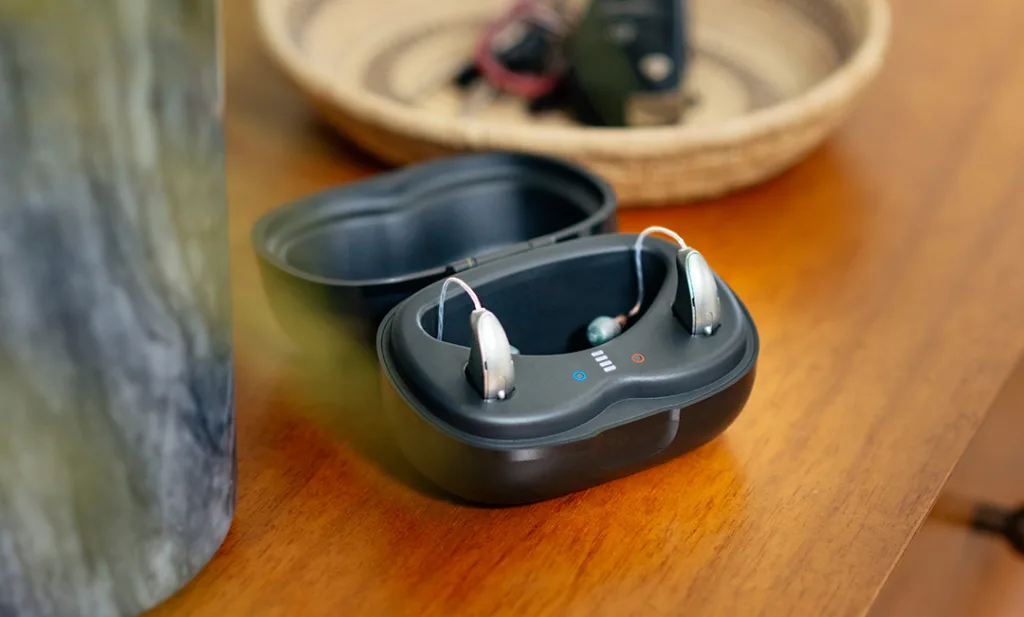
Behind-the-ear (BTE) aids have a plastic housing for the components which rests behind the ear. A clear plastic tube funnels amplified sound into an ear mold in the ear canal. This model, though developed decades ago, can be every bit as sophisticated as smaller hearing aids. In fact, it can hold more circuitry and amplify sounds to a greater degree than in-the-ear types. BTE aids can be more durable than other types and a few are even waterproof.

In-the-Ear
In-the-ear (ITE) aids house componentry in a custom- formed shell that fits within the outer portion of the ear. Its size and easy-to-use controls also may be helpful for those with limited manual dexterity.

In-the-Canal
In-the-canal (ITC) aids are smaller still, with a custom shell that fits down into the ear canal, and a smaller portion facing out into the outer ear. They are discreet, yet still visible within the outer ear.

Completely-in-the-Canal
The newest generation of hearing aids are those that fit completely-in-the-canal. Barely visible-and then only if someone's peering into your ear-the only clue to their existence is the head of a tiny plastic line with which you place or remove the aid.

ClCs are popular for their aesthetic appeal, but the physiology of some individuals' ears (i.e., a very narrow or small ear canal) may make this style unsuitable for them


Hearing aid fittings are just one part of the relationship you'll build with your SHA hearing professional. We believe successful aural rehabilitation must be structured individually to the needs of each patient. No two hearing losses are alike and each patient deserves personalized care and a rehabilitation program tailored for their specific needs.

Our hope is that we have provided information that will empower you, or someone close to you. If  you feel you have a hearing loss, we urge you to consult with a hearing professional to learn even more. If you have questions, please contact us today!


SoundPort
Do you depend on your mobile phone for constant communication? Are you tired of wire-dependant, "one-size-fits-all" solutions that fit poorly and sound even worse? Do the laws in your state ban the use of hand-held mobile phones while driving?
If so, you can have the ultimate mobile-communication solution. SoundPort, the world's first custom-fit, Bluetooth® EarSet for your Bluetooth-compatible mobile phone. SoundPort is designed for people who want the ultimate solution in lightweight, comfortable, hands-free, wireless communication.

Ask today how you can begin enjoying the ultimate in comfortable, hands-free, wireless communication with SoundPort.


Acousticon Of Flushing


39-01 Main St
Suite 206
Flushing, New York, 11354, US
Phone: (718) 445-3333